
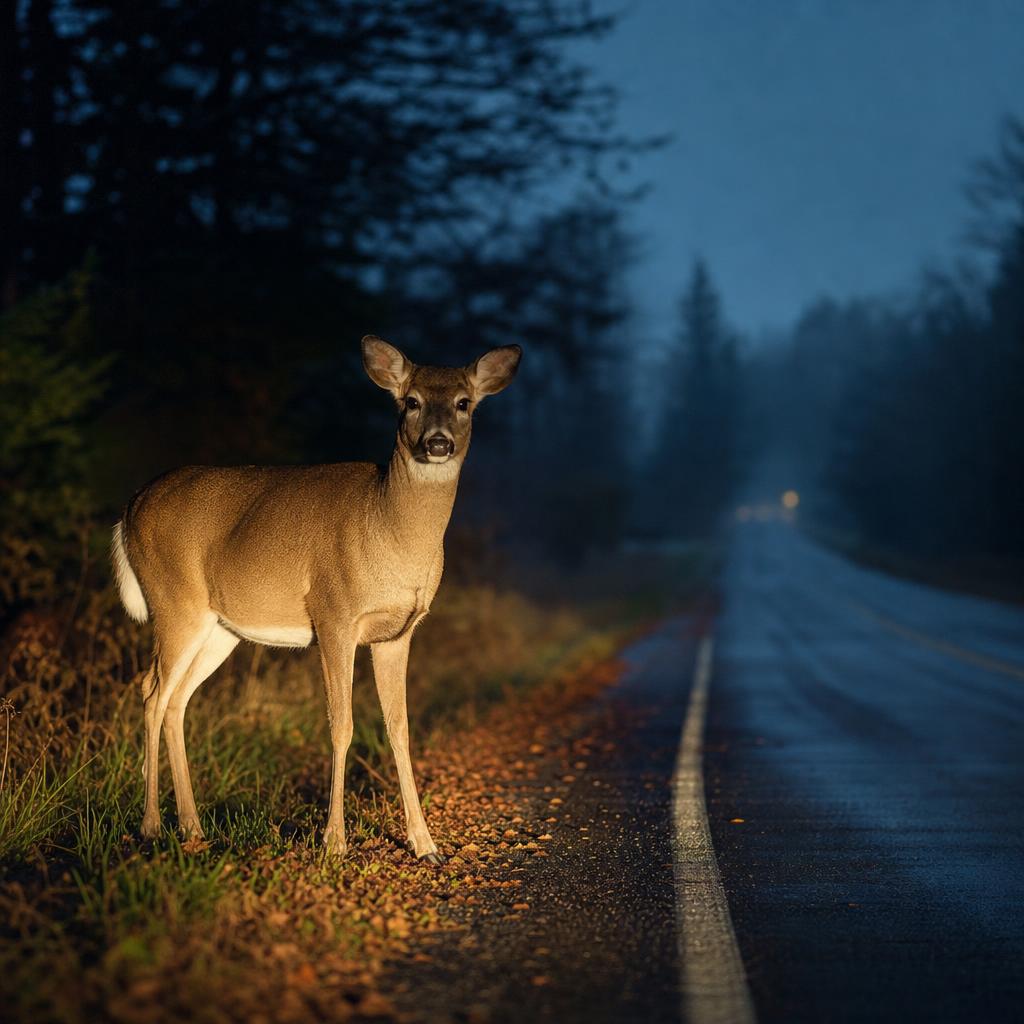
Do not chase the deer or approach it. Pull onto the shoulder, turn on your hazards, and stay belted until traffic clears. Call 911 or the local police and get a report number - your insurer will ask for it. Photograph the damage, the scene, and the road. Then check for leaking fluid, a hood that won't latch, deployed airbags, headlight or radiator damage, or a tire rubbing the fender. If any of those are present, do not drive the car - call for a tow. Hitting a deer is a comprehensive claim in Michigan, not an at-fault collision claim.
The First 10 Minutes
- 1Get off the road, then stay put.
Brake, hold the wheel with both hands, and bring the car to a controlled stop. Pull onto the right shoulder as far as you safely can and turn on your hazard flashers. Stay buckled and stay in the vehicle if you're in a live traffic lane - most secondary crashes happen to people standing next to a disabled car on a dark road.
- 2Call 911 or the local police.
Tell the dispatcher your location, whether anyone is hurt, whether other vehicles were involved, and whether the deer is alive, dead, or lying in the roadway. A carcass in a travel lane is a hazard to the next driver, and reporting it starts the cleanup. Ask for the report or incident number before the officer leaves - nearly every insurer will ask for it when you open the claim.
- 3Stay away from the deer.
An injured whitetail is powerful, panicked, and unpredictable. Hooves and antlers cause serious injuries every year to drivers who walked up to check on the animal. Let the responding officer handle it.
- 4Photograph everything before anything moves.
Front-end damage from several angles, the whole vehicle, the road and skid marks, any debris field, the deer if you can do it from a safe distance, and the road sign or mile marker showing where you are. Deer damage often hides behind a bumper cover that still looks intact - photos taken at the scene protect you if the adjuster later questions the severity.
- 5Decide whether the car is drivable - honestly.
Walk around it. Look for the warning signs in the section below. If you're on the fence, don't drive it. A cracked radiator or condenser will run a modern engine to overheat in a few miles, and that turns a bumper-and-fender repair into an engine bill.
- 6Call your insurer, then your shop.
You can open a claim from the shoulder of the road. You are not required to use the repair facility your insurer suggests - in Michigan, you choose the shop. Naming your shop on the first call keeps the vehicle from being towed to a storage lot that charges by the day.
This is the single most important habit to build before it happens. Swerving is how a survivable deer strike becomes a rollover, a tree, or a head-on. It also changes your insurance claim: hit the deer and it's comprehensive. Swerve, miss the deer, and hit a guardrail, a ditch, or another car, and it becomes a collision claim - usually a higher deductible, and potentially chargeable against you for leaving your lane. Brake hard, hold the wheel straight, stay in your lane.
Is Your Car Safe to Drive?
Deer strikes concentrate damage exactly where a car keeps itself alive: the grille, the cooling stack, the headlights, and the sensors behind the bumper. Do not drive the vehicle if you see any of the following.
- Fluid on the pavement - green, orange, or pink usually means coolant from a punctured radiator or condenser. Oily film means power steering, transmission, or engine oil.
- Steam, or a temperature gauge climbing - shut it off immediately.
- A hood that won't latch - a hood that unlatches at 45 mph blinds you completely.
- Deployed airbags - the vehicle is not roadworthy, and the restraint system needs to be scanned and replaced.
- Headlights out, or aimed at the sky - most deer crashes happen in the dark.
- Tire rubbing on the fender or wheel well, or the car pulling hard to one side - that's suspension or structural damage.
- Sharp metal or a bumper cover hanging into a tire.
- Fur, hide, or hoof marks packed into the grille - debris in the cooling fins blocks airflow even when nothing looks bent.
- Any new warning light, especially those for the forward camera, radar cruise, lane keeping, or automatic emergency braking. These require ADAS recalibration after any bumper work.
How the Insurance Claim Works in Michigan
This is where most Michigan drivers get surprised, so it's worth being precise. Under Michigan's no-fault system, damage from striking an animal is comprehensive coverage - the same bucket as theft, fire, hail, and a rock through the windshield. Comprehensive is optional in Michigan, but it is usually required by your lender if the vehicle is financed or leased.
| What happened | Which coverage pays |
|---|---|
| You hit the deer | Comprehensive, minus your comprehensive deductible. Generally treated as a not-at-fault claim. |
| You swerved, missed the deer, hit a tree, ditch, guardrail, or another vehicle | Collision, minus your collision deductible - which is often higher. Leaving your lane can also be treated as at-fault. |
| You or a passenger were injured | PIP (Personal Injury Protection) under Michigan no-fault, up to your chosen medical limit. |
| You carry liability only | No coverage for your own vehicle. Repairs come out of pocket. |
| Towing and rental | Only if you carry those optional add-ons. Both are inexpensive - worth checking your declarations page before deer season. |
Because comprehensive claims are not at-fault claims, a deer strike typically affects your renewal far less than a collision claim would. That is a real financial reason not to swerve - on top of the obvious one.
Do you have to report it to police?
Report it. Even when nobody is hurt, the police report number is what makes the claim process go smoothly, and it documents that the damage came from an animal rather than an unreported at-fault crash. If the deer is in the roadway, reporting also gets it removed before someone else hits it.
Can you keep the deer?
Yes. Michigan issues a free roadkill salvage permit through the DNR, and the driver who hit the animal has first right to it. You can apply online or tell the responding officer you intend to keep it. The permit doesn't cost anything, but you need it before you take the animal - and it can't be used if the animal was struck intentionally.
The Damage You Can't See
A deer weighing 130–200 pounds hitting a bumper at 50 mph delivers force comparable to a low-speed crash with another vehicle. What makes deer strikes deceptive is the geometry: the impact rides up over the bumper beam and loads the hood, cowl, windshield, and roof rail - areas that don't look damaged from ten feet away.
Here is what we routinely find at our Commerce Township shop on cars whose owners were told "it's just a bumper":
- Radiator, condenser, and cooling fan damage behind an undamaged-looking grille. This is the number one reason a drivable deer strike turns into a tow two days later.
- Bent radiator support and upper tie bar - structural components that determine whether your hood and headlights ever line up again. See our frame and structural repair page for how we address this.
- ADAS sensors knocked out of alignment. Forward radar lives behind the grille emblem or lower bumper; the forward camera sits at the windshield. A few millimeters of misalignment is enough to make adaptive cruise, lane keeping, and automatic emergency braking read the road wrong. These systems require documented ADAS recalibration after bumper or windshield work - not just a reinstall.
- Crash sensors and restraint-system faults that don't set a warning light until the next impact, when the airbag doesn't fire.
- Windshield, A-pillar, and roof-rail damage when the animal came over the hood. Our auto glass team handles replacement and recalibration in-house.
- Hidden corrosion setup - every scratch through the e-coat on a Michigan vehicle is a rust start point once road salt season begins in November, which is the same month deer crashes peak.
A complete estimate for deer damage includes a pre-repair diagnostic scan, a teardown to see behind the bumper cover, and a post-repair scan and ADAS calibration. If that isn't on the estimate, the estimate isn't finished. We document everything for your insurer - whether you're in Commerce Township, Wixom, Walled Lake, White Lake, Milford, or West Bloomfield.
When and Where Deer Crashes Happen in Michigan
Michigan has roughly 2 million deer and reports more than 58,000 vehicle-deer crashes a year - over 160 a day. Around 1,800 people are injured annually and a dozen or more are killed, most of them motorcyclists. About 80% of these crashes happen on two-lane roads.
The season: October through December
Roughly 25,000 of Michigan's annual deer crashes fall in that three-month window, with November alone accounting for about 10,000. Rut pushes bucks across roads with no regard for traffic, hunting pressure moves the herd, and the end of daylight saving time drops evening rush hour into full darkness. A second, smaller spike runs April through June, when yearlings disperse.
The hours: early morning and evening
The single highest-volume window for deer crashes in Michigan is 6:00 to 9:00 a.m., with a second peak from about 6:00 to 9:00 p.m. That first window is exactly the local commute along Wixom, Haggerty, Pontiac Trail, Union Lake, and Commerce Road - two-lane roads threading between subdivisions, parks, and lake frontage.
Oakland County is a hotspot, not a safe zone
People assume deer strikes are a rural problem. Oakland County reported over 2,000 vehicle-deer crashes in 2024 - second most of any county in Michigan, behind only Kent. Suburban Oakland County is close to a perfect environment for it: heavy commuter volume, wooded neighborhoods, parks and green corridors, lakes, and two-lane roads cutting straight through the paths deer walk every morning and evening. Commerce Township, Wixom, Walled Lake, White Lake, Milford, and West Bloomfield all sit in that mix.
How to Avoid Hitting a Deer
- Slow down at dawn and dusk, October through December. Speed is the one variable you control, and it decides everything about the outcome.
- If you see one deer, expect three. Deer move in single file. The one that crossed cleanly is usually not the last one.
- Scan the shoulders, not just the lane. Watch tree lines, fence rows, field edges, and anywhere the woods meet the road.
- Use your high beams whenever there's no oncoming traffic. On unlit two-lane roads this is the single biggest improvement in how early you see them.
- Take deer crossing signs literally. They're placed on documented crossing corridors, not at random.
- Brake early and hard - never swerve. Short horn bursts can move a deer that's frozen in the road; flashing your high beams often doesn't.
- Check your comprehensive deductible before November. The cheapest time to find out you don't have comprehensive coverage is not on the shoulder of Wixom Road at 6:40 a.m.
Frequently Asked Questions
Does hitting a deer raise your insurance in Michigan?
Usually far less than an at-fault crash would. Striking an animal is a comprehensive claim, which carriers generally treat as not-at-fault. Your overall claim history can still be a rating factor, so ask your agent before filing a very small claim that's near your deductible.
What if the deer ran off and I can't find it?
It doesn't change anything. Your claim is based on the damage to your vehicle, not on producing the animal. Report it to police, photograph the damage and the scene, and note deer hair or hide in the grille - that's your evidence.
Am I at fault for hitting a deer?
No. There is no at-fault driver in a single-vehicle animal strike. That changes if you swerved and struck another vehicle or object, which is why the advice is always to brake rather than swerve.
Can I drive my car after hitting a deer?
Only after checking for leaking fluid, a rising temperature gauge, a hood that won't latch, deployed airbags, headlight damage, a tire rubbing the fender, or new warning lights. Any one of those means call a tow. A cracked radiator that looks fine on the shoulder can overheat an engine within a few miles.
How long does deer damage take to repair?
A bumper cover, grille, and headlight typically runs a few days. Add radiator and cooling work, hood and fender replacement, structural straightening, or ADAS recalibration and it moves into one to three weeks depending on parts availability. We give you a written timeline with the estimate and update you as parts arrive.
Do I have to use the repair shop my insurance company recommends?
No. In Michigan you choose your repair facility. Your insurer can recommend a shop, but the decision is yours, and choosing your own shop does not affect your coverage.
Who pays for the tow?
If you carry towing or roadside coverage, your policy does. Otherwise it's typically added to the repair claim or billed to you. Either way, call us first - vehicles towed to a general impound or storage lot start accruing daily fees immediately.
What if my car is a total loss?
Your insurer pays actual cash value minus your comprehensive deductible. We can document condition, options, and pre-loss value from our teardown, which frequently matters when the first offer comes in low.
Hit a Deer? We'll Take It From Here.
Commerce Collision repairs deer strikes for drivers across Commerce Township, Wixom, Walled Lake, White Lake, Milford, and West Bloomfield. We tow, handle the estimate and insurance paperwork, and do the structural, paint, and ADAS calibration work in-house.
3080 E Oakley Park Rd, Commerce Township, MI 48390 · Open 6 days including Saturdays · 24/7 towing available
Sources
- Michigan State Police, Office of Highway Safety Planning — Vehicle Deer Crashes
- Michigan Traffic Crash Facts — annual deer crash reports
- Michigan Department of Natural Resources — Roadkill Salvage Permit program
This article is general information for Michigan drivers, not legal or insurance advice. Coverage depends on your specific policy — confirm details with your agent.

About the Author
Wesam "Sam" Behnam
Michigan State Certified Master Auto Mechanic (Cert. #1304862)
Certified in Unitized Body Structural Repair & Collision-Related Mechanical Repair. Sam leads the repair team at Commerce Collision in Commerce Township, MI.