
ADAS Calibration COMMERCE TOWNSHIP
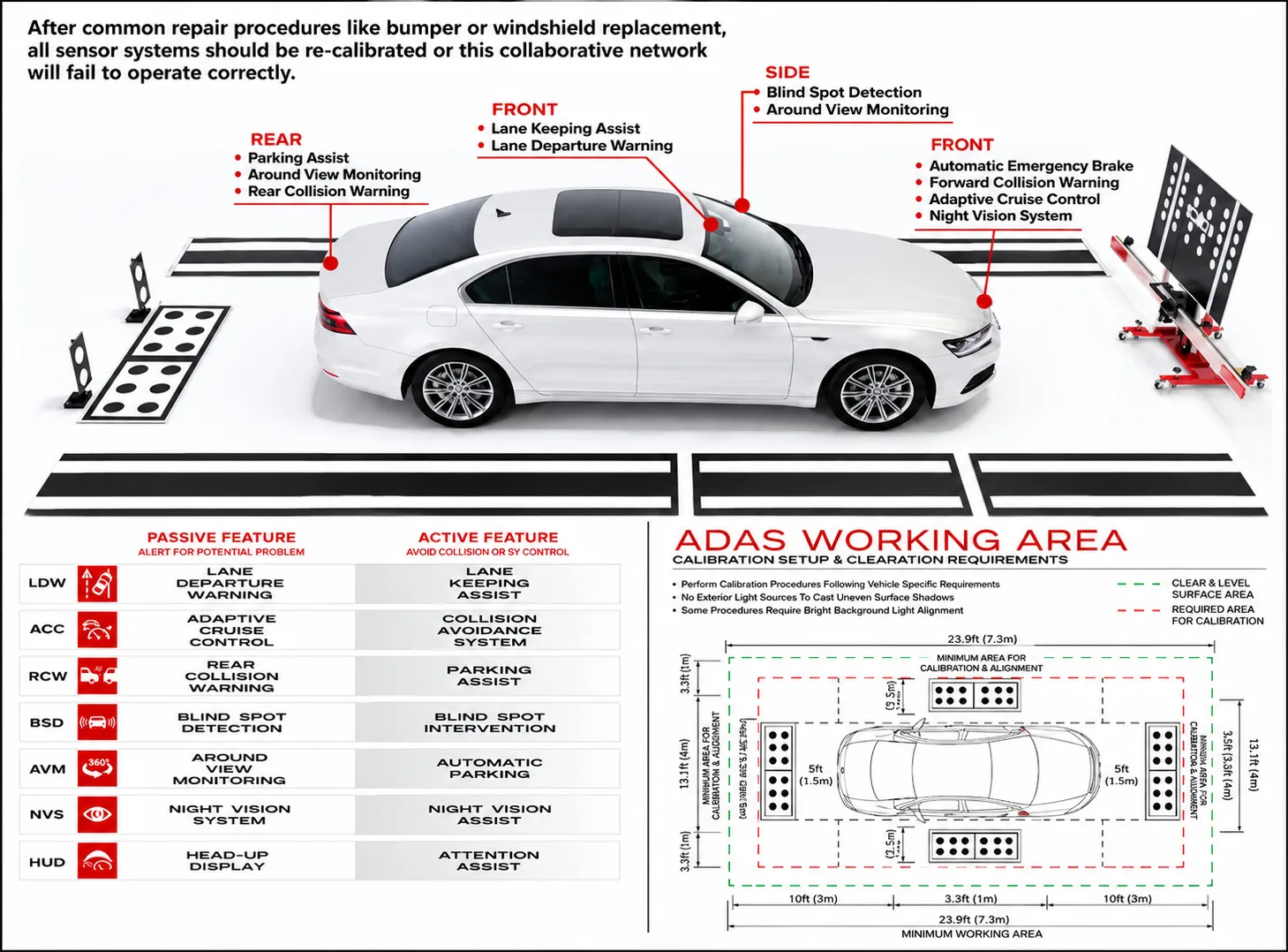
After any collision, windshield replacement, or suspension repair - your safety systems must be recalibrated. This is not optional.
Advanced Driver Assistance Systems - automatic emergency braking, lane departure warning, adaptive cruise, blind spot monitoring - are calibrated to millimeter precision. A displaced sensor or recalibrated camera can make the difference between a system that prevents an accident and one that causes one.
When Is Calibration Required?
ADAS calibration is required after any of the following:
- Windshield replacement - the forward-facing camera mounts directly to the glass
- Collision repair - any impact that moves body panels may displace sensors
- Front suspension or steering work - alignment changes affect radar and camera aim
- Bumper replacement - front radar sensors are integrated into bumper assemblies
- Wheel alignment - on ADAS-equipped vehicles, alignment must be followed by sensor re-aim
Static vs. Dynamic Calibration
Some vehicles require static calibration - performed in a controlled environment using a target board at a precise distance from the vehicle. Others require dynamic calibration - a road drive under specific conditions while the system re-learns. Many require both. We perform the procedure your vehicle's manufacturer specifies, not a shortcut.
Why This Cannot Be Skipped
A forward camera that's off by 1° can create a scenario where automatic emergency braking activates too late - or not at all - at highway speeds. If a shop completes your body repair or glass replacement without mentioning calibration, ask specifically whether it was done. A DTC code cleared is not the same as a system calibrated.
Our Process
- 1.Pre-ScanWe perform a full vehicle scan to document existing fault codes before any ADAS work begins.
- 2.Repair CompletionAll body, structural, glass, or alignment work is completed first - calibration always comes last.
- 3.Calibration SetupFor static calibration, we prepare the calibration zone with target boards at manufacturer-specified distances on level ground.
- 4.Calibration ProcedureWe follow the OEM-specified calibration sequence for your vehicle's make and model.
- 5.Post-Scan & VerificationA final scan confirms all fault codes are cleared and all systems report correctly before delivery.
See our other services: Collision Repair, Auto Glass, Frame & Structural Repair.